Part I · Chapter 6 of 27
Putting On Tilak
Tilaka refers to the markings which Vaisnava devotees apply to their bodies, to remind themselves and others that we are all eternal servants of Lord Krsna. The U-shaped mark represents the heel of Lord Visnu, and the oval part represents the Tulasi leaf. Tilaka is applied to twelve parts of the body, and the twelve names of the Lord are recited with each application. To apply tilaka, start with a little Ganges or Yamuna water (if you don't have any, get some water, and stirring it with your right middle finger, chant:
ganga cha yamune chaiva
godavari saravati
narmade sindho kaveri
jale 'smin sannidhim kuru
"O Ganges, O Yamuna, O Godavari, O Saravati, O Narmada, O Sindhu, O Kaveri, please become present in this water."
Tilak is made from gopi-chandana, a sacred clay from Dvaraka, sold as a hard cake or powder; the Krishna Store carries it. Put the water in your left hand, and rub the hard tilak into the water, creating a wet paste out of the clay. Begin by putting your ring finger of the right hand into the clay, and starting between the eyebrows, bring the finger straight up to the hairline, making two straight lines. It should look like a long, narrow U-shape. Then use some more tilak to make the Tulasi leaf on your nose, it should extend about 3/4 of the way down your nose. As you apply the tilak to your body, chant the following mantras:
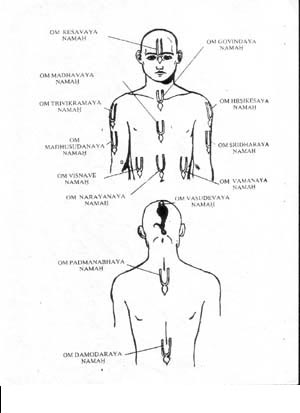
forehead |
om keshavaya namaha |
belly |
om narayanaya namaha |
chest |
om madhavaya namaha |
neck |
om govindaya namaha |
right belly |
om vishnave namaha |
right arm |
om madhusudhanaya namaha |
right shoulder |
om trivikramaya namaha |
left belly |
om vamanaya namaha |
left arm |
om shridharaya namaha |
left shoulder |
om hrishikeshaya namaha |
upperback |
om padmanabhaya namaha |
lower back |
om damodaraya namaha |
Take the remaining tilak, and wipe it on the back of the head, in the area of the sikha, and chant om vasudevaya namaha.
Lord Shiva says to Parvati that in the middle of the tilak marking there is a space, and in that space reside Lakshmi and Narayana. Therefore the body that is decorated with tilaka should be considered a temple of Lord Vishnu.